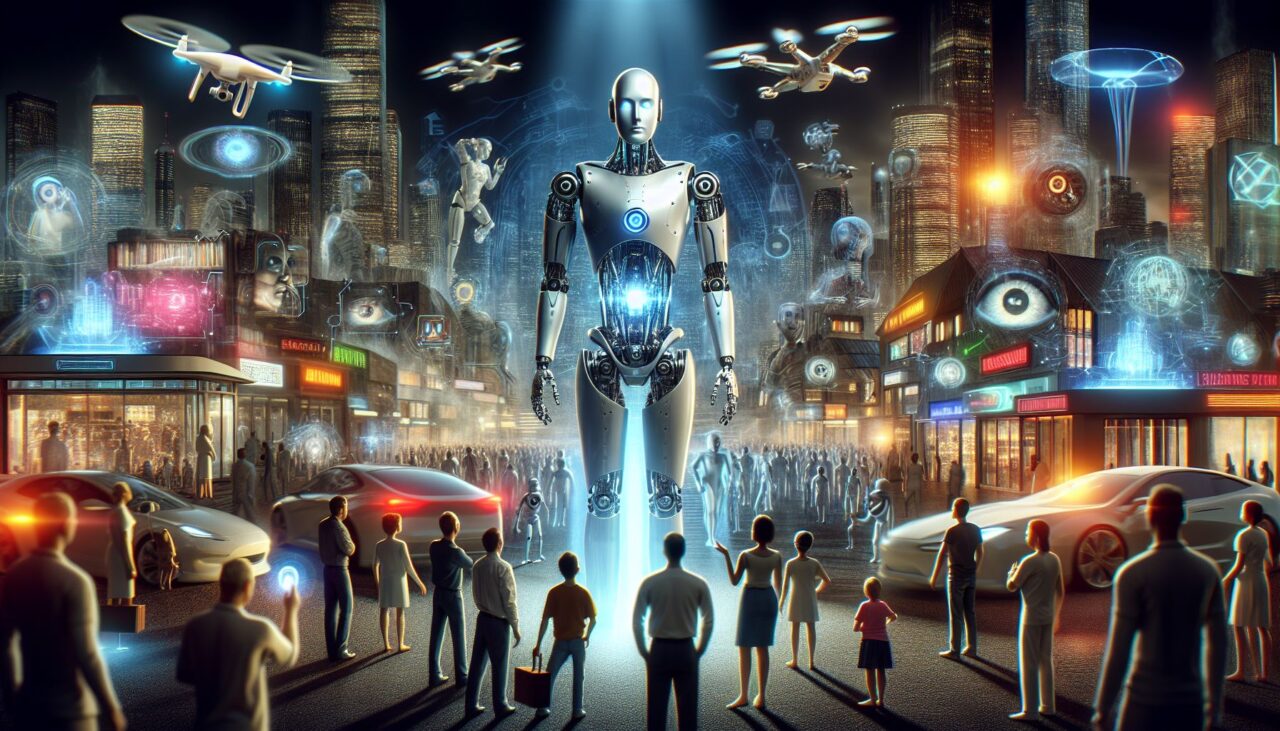
Hey there, fellow tech enthusiasts! Ever wake up and think, “Man, I really hope today’s the day AI becomes so advanced it renders human labor obsolete”? No? Just me? Okay, maybe that’s a tad dramatic, but I’ll gladly admit I’m a full-fledged AI optimist. The age of Artificial Intelligence is upon us, and frankly, I’m psyched. Grab a cup of coffee (or tea, if that’s your jam), and let’s dive into the wild world of AI and why it’s not the gloom and doom scenario science fiction sometimes paints it to be.
The AI Boom: More Than Just Siri’s Smarter Cousin
Let’s start with the basics. AI, or Artificial Intelligence, has been making headlines for decades, but only recently has it reached a point where it’s genuinely starting to change our daily lives. I mean, sure, it started innocently enough with a little game of chess—props to IBM’s Deep Blue for making garish pixelated chess pieces cool in ’97. But now, AI is way more than just a nerd’s ultimate board game companion.
Here’s the kicker: AI’s gone from being an over-glorified calculator to a multifunctional beast that handles tasks we thought required that special human touch. Self-driving cars cruise down the freeway with more grace than my parallel parking attempts. AI-powered personal assistants keep me slightly less disorganized. The capabilities are growing exponentially, and it’s wild to watch.
AI and Creativity: Not Just Another Brick in the Wall
Let’s be real—there’s something a bit unnerving about the fact that AI can now crank out music, art, and even write screenplays. But folks, it’s time to stop resisting and hop on this creativity bandwagon.
Take AI in the music industry, for example. AI algorithms are working with musicians to create hit songs by analyzing existing music and understanding what resonates with listeners. And get this—some AI programs are even capable of writing original pieces that make you question if a human heart really composed it. It’s like having a jam session with a silicon-based Mozart.
Wait, there’s more: Visual arts are fair game too. AI-generated art is showing up at exhibits where our binary cousins are painting (okay, coding) alongside seasoned artists. Imagine AI being your art buddy, nudging your creative projects forward when you’re stuck with that ‘blank canvas syndrome’.
The Fourth Industrial Revolution: AI’s Game-Changing Role
Ah, the Fourth Industrial Revolution. Decades from now, history books will probably slap a Pinterest-worthy label on our era, and we’ll have AI to thank for most of it. Beyond our daily grind, AI is cutting through complex industries—manufacturing, logistics, finance—basically anywhere it can sneak in and optimize processes like a superhero coder.
Consider this: In manufacturing, AI is improving supply chain management and predictive maintenance to keep machines running smoothly. Logistic companies rely on AI to plot out the fastest delivery routes, optimizing fuel costs and keeping grandma’s birthday gift from showing up AFTER the party (not this year, Amazon!).
AI Ethics and Challenges: Welcome to the Uncanny Valley
To be fair, no conversation about AI should ignore the ethics gray area. While the technology is impressive, it comes with challenges—privacy concerns, bias in algorithms, and job displacement, just to name a few. These are real issues, folks. We shouldn’t pretend they’re as thin as a ghost echo in the cloud.
For the record: We need transparency and fairness. AI needs to be built on diverse data to make sure it doesn’t become the human equivalent of playing a broken record. And yes, the ethical debate can get as heated as pineapple-on-pizza discussions, but keeping an open dialogue going is essential as this technology develops.
The Future of AI: BFFs with Bots?
We’ve only scratched the silicon surface, but there’s still a long way to go. The future of AI is buzzing with potential—think personalized learning systems changing education or sophisticated healthcare diagnostics transforming how we treat diseases, all thanks to AI’s reach.
Let’s speculate a bit: We might eventually get to a point where AI systems can predict world events or work tirelessly in labs to discover new elements in the periodic table, leading to technological marvels that challenge our current assumptions and open up new realms of possibilities.
So, what’s my take? I believe in the promise of AI not because it’s a magic bullet or solves every problem but because it pushes the boundaries of what’s possible. It amplifies human capability and nudges us ever forward into new horizons. Plus, I’m all-in for a future where buzzing bots fetch me the perfect latte while I dream about tomorrow’s tech. Cheers to that!
And hey, thanks for joining me on this wild ride. Together, we’ll keep peering into the future, one line of code at a time. Until next time!