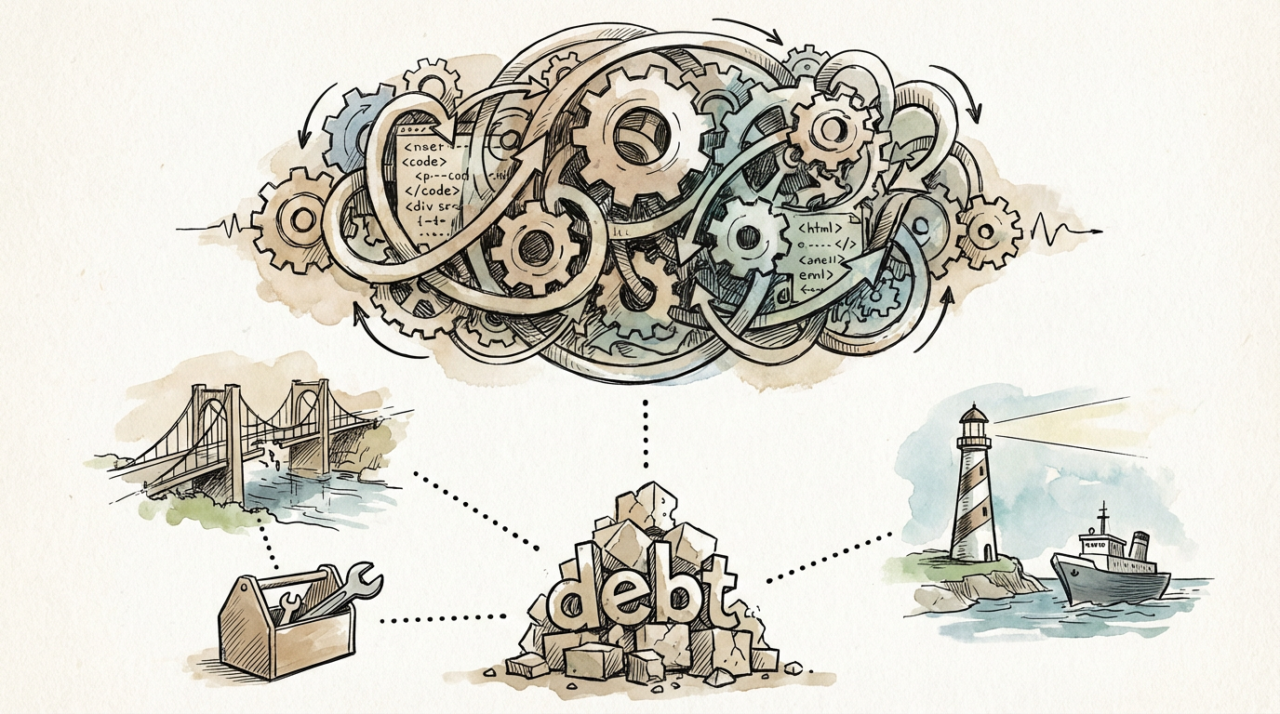
When the Chickens Come Home to Roost
I’ve been writing production code for fifteen years, and I can tell you that technical debt isn’t just some abstract concept you read about in engineering blogs. It’s the 3 AM phone call when the authentication service crashes because someone decided to “temporarily” store session tokens in memory back in 2019. It’s the three-week feature that stretches to three months because the codebase has grown into a labyrinth of shortcuts and workarounds.
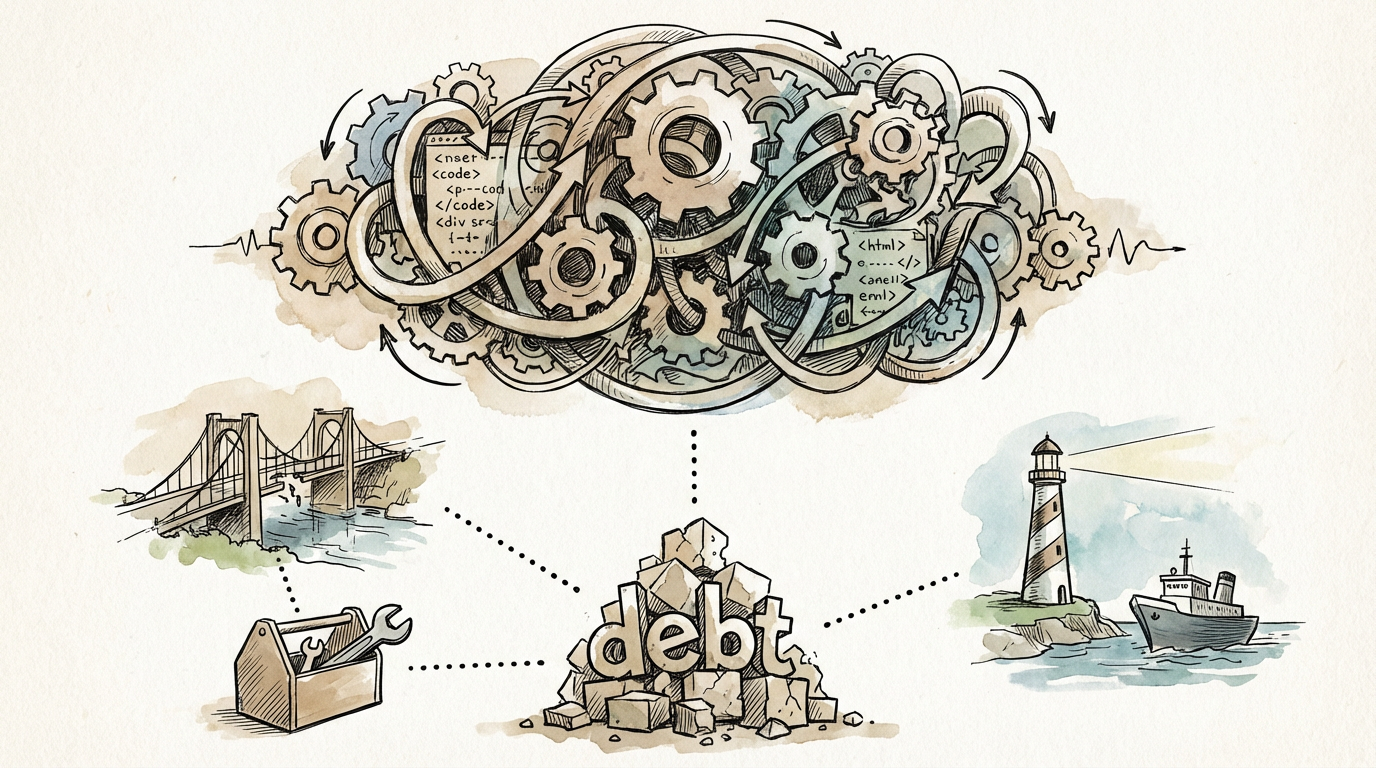
The hardest lesson I learned came during my stint at a fintech startup where we put speed above everything else. We shipped features fast, impressed investors, and hit every deadline. For eighteen months, we were heroes. Then the weight of accumulated shortcuts started crushing us. Simple changes required touching dozens of files. The test suite took hours to run and failed randomly. New engineers spent weeks just understanding how data flowed through our system.
That experience taught me something I wish I’d learned earlier: technical debt isn’t inherently evil, but treating it like credit card debt will destroy you. You can’t just make minimum payments and hope it goes away.

The Archaeology of Bad Decisions
Before you can fix technical debt, you have to understand what you’re dealing with. Most teams approach this backwards. They start by identifying what feels broken today, but that’s just treating symptoms. The real work is archaeological.
Start with your deployment pipeline. How long does it take to get a one-line change into production? If it’s more than thirty minutes, you’ve got process debt. Look at your test coverage, but more importantly, look at test execution time. Tests that take forever to run don’t get run. That’s confidence debt, and it’s expensive.
Then dig into the code itself. I use a simple heuristic: if explaining a piece of code to a new team member requires more than two sentences, it’s probably carrying debt. Complex conditional logic, deeply nested functions, and classes with more than five dependencies are all red flags. Document these patterns, but don’t try to fix them yet.
The most insidious debt is architectural. This shows up as tight coupling between components that should be independent, or as business logic scattered across multiple layers. I once inherited a system where user authentication logic lived in fourteen different files. Every auth-related feature required touching the entire codebase. It was a nightmare.
Strategic Debt Reduction
Here’s what doesn’t work: declaring a “tech debt sprint” and hoping to clean everything up in two weeks. I’ve seen this approach fail spectacularly because it treats all debt as equivalent. It’s not.
Categorize your debt by impact and effort. High-impact, low-effort fixes go first. These might be adding logging to black-box functions, extracting configuration from hardcoded values, or writing integration tests for critical user flows. These changes provide immediate value and build momentum.
For larger architectural debt, I use the strangler pattern religiously. Don’t rewrite the monolith. Gradually replace it. When you need to add a feature to a problematic area, write the new functionality cleanly and slowly migrate existing behavior. This approach lets you improve the system while delivering business value.
The key is making debt reduction part of regular feature work, not a separate activity. Every pull request should leave the codebase slightly better than it was. This means refactoring as you go, adding tests for code you touch, and improving documentation for systems you modify.
Building Debt Resistance
Prevention is more effective than cures, but it requires discipline and the right organizational support. Code reviews are your first line of defense, but only if reviewers actually have time to think critically about the code they’re reviewing. Rubber-stamp reviews create more debt than no reviews at all.
I’ve found that pairing debt metrics with business metrics works better than tracking technical metrics alone. Instead of reporting “test coverage decreased by 5%,” report “feature delivery time increased by 30% because of debugging.” Business stakeholders understand time and reliability. They don’t inherently understand cyclomatic complexity.
Automated tooling helps, but tools without context create noise. Static analysis that flags every function longer than twenty lines isn’t useful. Configure your tools to catch the specific problems your team tends to create. If you struggle with database performance, implement query analysis. If you have dependency management issues, add dependency scanning.
The most important preventive measure is cultural. Teams that treat code quality as a shared responsibility create less debt than teams where quality is one person’s job. Make sure everyone understands that shipping fast today by creating problems tomorrow isn’t actually shipping fast.
Living with Perpetual Imperfection
After fifteen years of building software, I’ve accepted that perfect codebases don’t exist at scale. Every system carries some debt, and that’s fine. The goal isn’t elimination. It’s management.
Some debt is strategic. Taking shortcuts to validate product-market fit makes sense, as long as you plan to address those shortcuts once validation succeeds. The problems come when temporary solutions become permanent by neglect, not by choice.
I’ve learned to distinguish between debt that constrains future development and debt that simply offends my aesthetic sensibilities. A function with an ugly name but clear behavior isn’t worth refactoring. A tightly-coupled module that prevents horizontal scaling absolutely is.
The most successful teams I’ve worked with treat technical debt like financial debt: they track it, they budget for it, and they make conscious decisions about when to take it on and when to pay it down. They don’t let it accumulate unchecked, but they also don’t panic when some debt exists.
Managing technical debt is ultimately about making informed tradeoffs under uncertainty. You won’t always get it right, but with experience, you’ll get better at recognizing which shortcuts will haunt you later and which ones are just expedient solutions to real problems. If you’ve got war stories of your own about technical debt battles won or lost, I’d love to hear them.